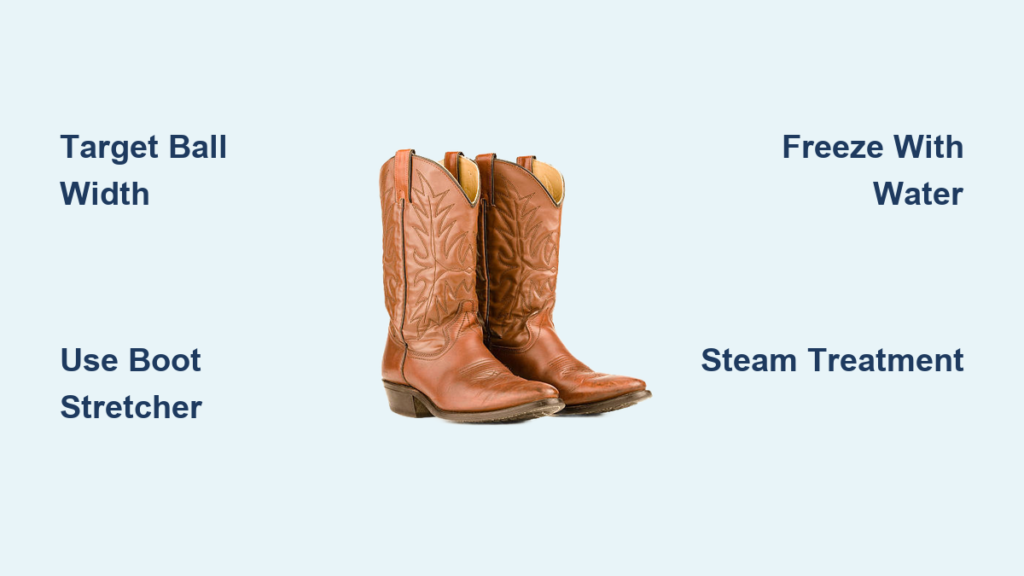
Your new cowboy boots look fantastic but feel like medieval torture devices. That pinching sensation across your toes or tightness around your ankle means you’ve got a break-in problem that needs solving—fast. Professional stretching services cost $15-75 per pair, but you can achieve similar results at home with the right techniques. Most quality cowboy boots will stretch 1/4 to 1/2 size with proper home methods, transforming uncomfortable footwear into your favorite daily companions.
Don’t make the mistake of wearing your stiff new boots for hours hoping they’ll magically soften—they won’t without proper intervention. This guide reveals proven home stretching techniques that match your specific leather type and problem areas. Whether you’re dealing with pinching insteps, cramped toes, or constricting calf shafts, you’ll learn how to safely expand your boots using household items or affordable tools. The key is understanding your boot’s construction and applying the right amount of pressure in the right places.
Pinpoint Exactly Where Your Boots Need Stretching
Before applying any stretching technique, determine precisely where your boots fight back. Slide your foot inside wearing the socks you’ll typically pair with these boots. Walk around for five minutes, then note specific pressure points: Is the ball of your foot screaming? Does the instep strangle your foot? Are your toes kissing the front? Maybe the shaft constricts your calf or your heel slips with every step.
Different leather types respond dramatically to stretching. Full-grain leather—the most common in quality boots—can expand up to 15% width-wise and loves moisture-based methods. But exotic leathers demand caution: snakeskin stretches maximum 5%, ostrich handles 10-12%, while alligator barely gives 3-5%. Suede and rough-out leather forgive mistakes with 20% stretch potential.
Clean your boots thoroughly with leather cleaner 24 hours before stretching, then apply quality conditioner. This prevents cracking and prepares the leather for manipulation. Remove any removable insoles and stuff the boots with paper to maintain shape during the process—this crucial step prevents unwanted deformation in areas that don’t need stretching.
Why Your Ball Width Needs Special Attention
Most cowboy boot discomfort centers on the ball width—the widest part of your foot where leather stretches least naturally. When this area pinches, you’ll develop blisters with every step. Target this trouble spot by applying stretching solution directly to the interior leather across the ball area, then immediately wear thick socks with your boots for 30-45 minutes while flexing your feet.
How to Diagnose Instep Pressure Problems
If your boot presses down on the top of your foot like a vice, you’ve got instep issues. This area requires surgical precision—overstretch here ruins boot structure permanently. Test by pressing your thumb along the instep seam; if it barely gives, you’ll need a combination of steam treatment plus a boot stretcher with an elevated plug positioned under the throat line.
Transform Stubborn Boots With a Professional Stretcher

A professional boot stretcher delivers the most controlled, even results for stubborn cowboy boots. This $25-50 investment pays for itself after one use compared to cobblers’ fees. You’ll need the stretcher, small stretching plugs for targeted pressure, and either commercial stretching spray or a 50/50 rubbing alcohol-water solution.
Insert the stretcher ensuring the toe piece aligns perfectly with your boot’s toe box. Position stretching plugs directly over your identified problem areas—use oval plugs for bunions, long plugs for high insteps, or ball-and-ring attachments for wide forefeet. Lightly spray the interior leather with your stretching solution, focusing on tight spots.
Turn the stretcher handle 2-3 full turns clockwise until you feel resistance. Resist the urge to crank aggressively—two millimeters makes a dramatic difference. Leave the stretcher in place for 6-8 hours, then remove and test fit with your regular boot socks. Repeat the process, increasing tension by half-turn increments over 48-72 hours. Never exceed three full turns total—overstretching causes permanent damage.
Fix High Insteps Without Ruining Boot Structure
For high instep pressure, combine a shoe stretcher with an elevated plug positioned under the throat line. Apply steam treatment focused along the instep seam, then insert the stretcher at half-tension. Leave for 4 hours, then test fit. Increase tension by quarter-turns every session, checking progress every two hours. This gradual approach prevents the leather from developing unsightly bulges while providing relief.
Freeze Your Way to Comfort With Water Expansion
The freezer method works brilliantly for most leather types, using water’s natural 9% expansion when frozen. Fill two zip-lock bags with water, squeeze out excess air, and position them inside your boots at the tightest areas. Freeze overnight, then immediately wear the boots with thick socks while walking for 30-45 minutes as the leather warms and becomes pliable.
For targeted stretching, mix one part rubbing alcohol with three parts warm water. Dampen (never soak) the interior leather at problem areas, then immediately wear your boots with the thickest socks you own. Walk continuously for 1-2 hours, flexing your feet frequently. Apply medium heat from a hairdryer while wearing, focusing on stubborn spots. Condition thoroughly once cooled—this step prevents cracking as the leather settles into its new dimensions.
Steam Treatment for Exotic Leather Success

Steam delivers professional-grade results when done carefully. Hold each boot over steam from a kettle or garment steamer for 30 seconds, concentrating on interior problem areas. While warm and pliable, insert boot trees or wear with thick socks. Maintain pressure until completely cool—usually 2-3 hours. This method works exceptionally well for exotic leathers when gentler methods fail, but never apply direct steam to snakeskin—the delicate scales will separate.
Accelerate Break-In With Natural Wear Techniques
Sometimes the best approach mimics how boots were meant to break in—gradually through normal wear. Start with thin dress socks for 2-3 hours daily during week one. Progress to medium-weight socks for 4-5 hours in week two. By week three, wear thick boot socks for full days. Week four adds a second sock layer if you need additional stretch.
Accelerate this process by applying leather stretching spray before each wear, then using a hairdryer on medium heat for 2-3 minutes before putting boots on. Focus heat on the tightest areas while flexing your foot inside the boot. The first 30 minutes of wear are crucial—keep walking continuously while the leather cools and molds to your foot. Pro tip: Wear your boots while doing household chores where you can sit periodically—this reduces blister risk while maintaining consistent pressure.
Target Calf Tightness With Rolling Pin Technique
For shaft tightness, insert a wooden rolling pin into the calf area and roll it back and forth while applying downward pressure. Focus on constricting areas for 10-15 minutes, then rotate the boot 180° and repeat. This gentle, controlled pressure works particularly well for shaft issues without risking the boot’s structural integrity. Follow with 15 minutes of wearing the boots with thick socks to lock in the expansion.
Avoid These Stretching Disasters
Overstretched boots display wrinkled leather, loose fit, or structural deformation. Recover by inserting moleskin patches in loose areas, adding thicker insoles or heel grips. Severe cases require professional reconditioning to restore proper fit.
Critical warning: Never stretch boots with glued soles—they may separate during the process. Avoid stretching patent leather, vintage boots, or those with decorative stitching. Maximum safe limits include 1/4 size length increase, 1/2 size width expansion, 1/4 inch instep height gain, and 2 inches calf circumference growth.
When to Call a Professional Instead
Professional boot stretching costs $15-25 for basic leather, $35-50 for exotic skins, and $50-75 for complex modifications. Consider professional help if:
– Your boots feature exotic leathers like snakeskin or alligator
– Previous DIY attempts caused damage
– You need more than 1/2 size expansion
– The boots have intricate stitching or decorative elements
Alternative solutions when maximum stretch fails include lacing system conversion (adding elastic gussets), zipper installation for shaft tightness, or purchasing 1/2 size larger in width for future purchases.
Lock In Your Perfect Fit With Post-Stretch Care
Immediately after achieving desired stretch, clean boots with a damp cloth to remove any stretching solutions. Apply leather conditioner while leather remains warm from the process—this prevents cracking and helps maintain the new shape. Insert boot trees overnight to set the expansion.
During the first month, condition boots every 2-3 weeks as the leather settles into its new dimensions. Use boot trees whenever you’re not wearing them to maintain shape. Rotate wearing with other boots to allow leather recovery time. Most boots need re-stretching after 6-12 months of regular wear as leather naturally contracts.
Your cowboy boots should now feel like trusted companions rather than foot-binding devices. Remember that properly stretched boots become more comfortable with age, developing character that mass-produced comfort footwear can never match. The key is gradual, patient stretching matched to your specific leather type and problem areas—take your time, and these techniques will rescue countless boots from the back of closets, turning them into daily favorites.