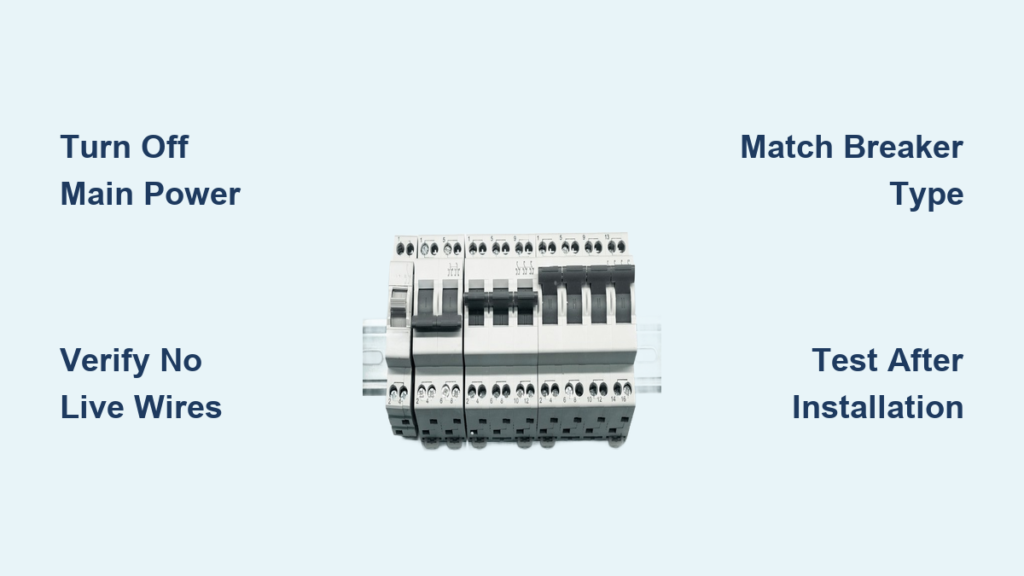
That sudden power outage hitting half your kitchen while you’re cooking dinner? Or your entire bathroom losing lights during your morning routine? When a circuit breaker trips repeatedly and refuses to reset, it’s not just an inconvenience—it’s a serious warning sign. How to replace a breaker at home becomes critical knowledge when standard troubleshooting fails, as faulty breakers cause over 2,000 residential fires annually. While electricians charge $150-$300 for this service, you can safely complete this intermediate electrical task yourself in under 30 minutes for less than $15—if you strictly follow safety protocols. This guide delivers the exact steps, brand-specific requirements, and life-saving precautions you need to replace a home circuit breaker without risking shock or fire.
Critical Safety Gear for Home Breaker Replacement

Never touch your electrical panel without these essentials—a single mistake can prove fatal. Start with ANSI-rated safety glasses to shield eyes from sparks and insulated gloves (1000V minimum rating) that form your primary defense against shock. Pair these with rubber-soled shoes and a headlamp for hands-free illumination inside the dim panel. Your non-contact voltage tester ($15-$25) is non-negotiable; verify it works on a live outlet before approaching the panel. Use only VDE-certified insulated screwdrivers with fully coated handles—never standard tools.
The deadly oversight most DIYers miss: Even with the main breaker OFF, the main lugs (thick service wires entering the top of your panel) remain energized at 240 volts. Test every surface with your voltage tester before touching anything, and maintain the “one hand rule”—keep one hand in your pocket when working near live components to prevent current from crossing your heart.
Find Your Exact Breaker Model for Safe Replacement

Confusing breaker brands causes catastrophic panel failures. Before removing a single screw, document three critical details visible through your panel’s window: brand (check labels for Square D, Siemens, Eaton, or Federal Pacific), amperage (15A, 20A, or 30A stamped on the handle), and type (single-pole for standard circuits, double-pole for 240V appliances like dryers). Take clear photos of both the panel label and the faulty breaker itself.
Critical compatibility rule: Never substitute brands—even if dimensions seem identical. Square D panels require QO or Homeline breakers, Siemens needs QP series, and Eaton panels demand BR-type. Bring your old breaker to the store; hardware stores often stock universal breakers that violate UL safety standards. For AFCI/GFCI breakers, match the exact model number (e.g., “HOM120CAFIC” for Square D) since wiring configurations vary.
Step-by-Step Power Shutdown Before Breaker Replacement
- Kill branch circuits: Turn OFF the main breaker (largest switch at panel top) to de-energize all circuits
- Verify de-energization: Test your target circuit’s outlets with a plug tester—no power should register
- Confirm main lugs remain live: Use your non-contact tester on the thick service wires (do NOT touch)
- Remove cover safely: Unscrew the panel cover (6-8 perimeter screws), lifting straight out to avoid wire contact
- Final wire check: Test the black hot wire at your target breaker with the voltage tester
The $500 mistake: Assuming the main breaker kills all power. Those live main lugs can deliver 200+ amps—enough to vaporize tools and cause arc flash burns. If your tester beeps near the lugs, STOP and call an electrician immediately.
Safely Remove a Stuck or Damaged Home Circuit Breaker
With power confirmed OFF, locate the black hot wire connected to your faulty breaker. Loosen its terminal screw 2-3 turns counterclockwise with an insulated screwdriver. Gently pull the wire straight out—never twist or bend it. For 120V circuits, also disconnect the white neutral wire from the neutral bar (note its exact position).
Breaker removal technique: Grip the center of the breaker firmly and pull straight outward with steady pressure. It clips onto the hot bus bar, so avoid side-to-side wiggling that could damage the tab. For GFCI/AFCI breakers, also disconnect the coiled white neutral wire from the neutral bar. Set the old breaker aside—many stores offer core exchanges.
Proper Installation Steps for Your New Home Breaker
Seating the breaker: Align the new unit’s clip with the bus bar rail and press firmly until it snaps into place. It should sit perfectly flush with adjacent breakers—any gap indicates improper installation. For GFCI/AFCI models, route the coiled white neutral wire to the neutral bar before connecting circuit wires.
Wire connection protocol: Insert the black hot wire fully into the terminal so copper is visible but no insulation protrudes. Tighten clockwise until snug, then add exactly 1/4 turn—overtightening cracks terminals. For GFCI breakers, connect the circuit’s white wire to the “LOAD NEUTRAL” terminal on the breaker, NOT the neutral bar. Double-check all connections with a torque screwdriver if specified by the manufacturer.
Power-Up Sequence After Replacing a Home Breaker
- Replace the panel cover, ensuring no wires are pinched along the edges
- Tighten cover screws evenly in a star pattern to avoid panel warping
- Turn ON the main breaker at the panel top
- Toggle your new breaker to the ON position
- Test circuit functionality using multiple outlets and lights
- For GFCI/AFCI: Press TEST (should trip), then RESET (should hold)
Critical first-hour monitoring: Place your hand near (not on) the breaker for warmth—any heat within 30 minutes indicates dangerous resistance. Listen for buzzing or sizzling sounds that signal arcing. If the breaker trips immediately, power down and investigate shorts before retrying.
Fix Immediate Issues After Home Breaker Replacement
Breaker trips instantly: Calculate total circuit load—add up all device wattages (e.g., 1,500W space heater + 800W microwave = 2,300W on a 20A/2,400W circuit). Stay below 80% capacity (1,920W for 20A). Check for short circuits by inspecting outlets for burnt wires or loose connections.
Breaker won’t seat: Shine your headlamp into the bus bar slot—bent tabs or melted plastic debris will prevent proper seating. Never force it; this requires professional panel repair. For short wires, use wire nuts with 6-inch THHN extensions (matching original gauge), never stretch existing wires.
GFCI won’t reset: Verify the coiled neutral wire connects securely to the neutral bar. Test with a GFCI outlet tester—if it trips but won’t reset, moisture may be present in outdoor circuits.
7 Clear Signs You Need an Electrician for Breaker Replacement
Stop work immediately if you see:
– Burn marks or melted plastic on the bus bar (indicates dangerous arcing)
– Aluminum wiring (requires COPALUM crimps and anti-oxidant compound)
– Challenger or Zinsco breakers (both recalled due to fire hazards)
– Shared neutrals (one white wire serving multiple circuits)
– Rust or corrosion inside the panel (signals moisture intrusion)
– More than 3 breakers showing heat damage simultaneously
– Panel label stating “Do not load center” (indicates obsolete equipment)
Hard truth: 47% of DIY electrical fires stem from incompatible breakers. If your panel brand isn’t clearly labeled or you see Federal Pacific (FPE) breakers, evacuate and call a pro—these panels have 2.4x higher failure rates.
Real Cost to Replace a Home Breaker Yourself vs. Hiring a Pro

| Breaker Type | DIY Cost | Pro Cost | When DIY Makes Sense |
|---|---|---|---|
| Standard single-pole (15-20A) | $3-$15 | $150-$250 | Confirmed single-breaker failure in modern panel |
| GFCI breaker | $35-$60 | $200-$300 | Bathrooms/outdoors where protection is required |
| AFCI breaker | $40-$80 | $225-$350 | Bedrooms under current electrical codes |
| Double-pole 240V | $10-$50 | $250-$400 | Dryer/range circuits with matching amperage |
| Zinsco/Challenger replacement | N/A (panel replacement needed) | $1,500-$3,000 | Never attempt DIY—immediate fire hazard |
Smart savings tip: Buy breakers in 3-packs if your home is over 15 years old—older panels often have multiple failing breakers. Avoid “universal” breakers sold online; they lack UL listing and void insurance coverage.
Prevent Future Breaker Failures with These Maintenance Steps
Monthly: Open your panel (with main breaker OFF) to inspect for:
– Heat damage: Discoloration on breaker handles or surrounding plastic
– Corrosion: White/green powder on terminals (indicates moisture)
– Loose wires: Gently tug connections—no movement should occur
Quarterly: Test all GFCI/AFCI breakers using their TEST/RESET buttons. Replace any that won’t reset within 30 days.
Annual professional check: Required for homes over 20 years old—electricians use thermal cameras to detect hidden resistance points. Never ignore a breaker that feels warm during normal operation; this indicates dangerous current leakage requiring immediate replacement.
Replacing a home circuit breaker correctly takes just 25 minutes when you prioritize safety over speed. Remember: test twice, connect once, and never compromise on brand compatibility. If you follow these steps precisely, you’ll restore power safely while avoiding the leading cause of preventable electrical fires. But when in doubt—especially with aluminum wiring or obsolete panels—calling a licensed electrician isn’t an expense, it’s the ultimate safety investment for your home.