
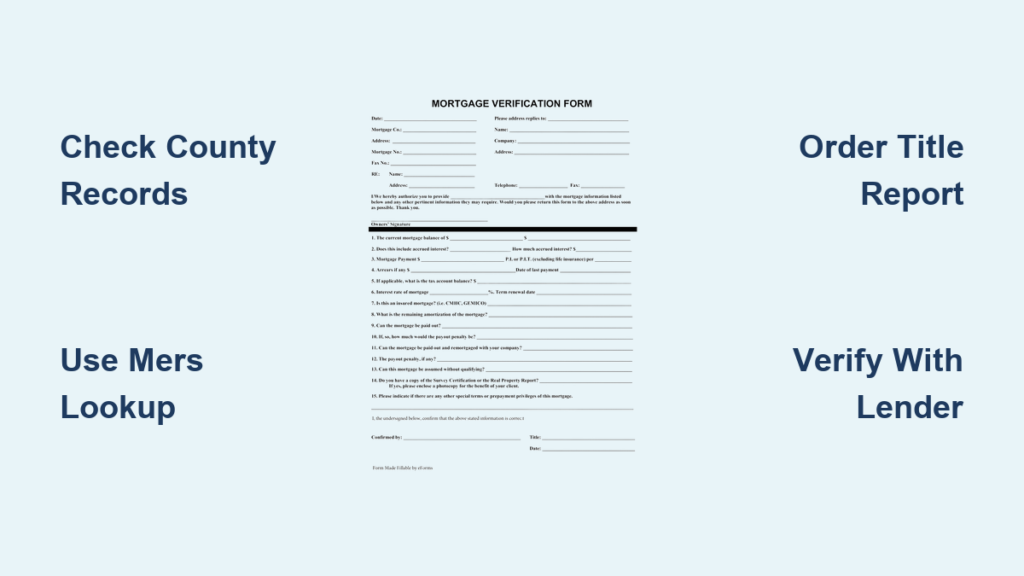
That house down the street with the “For Sale” sign? The vacant property you’re eyeing for investment? Knowing exactly how to find out if a home has a mortgage separates informed decisions from risky guesses. Whether you’re a buyer verifying liabilities, an heir confirming estate assets, or an investor analyzing opportunities, this guide delivers proven techniques to uncover mortgage status in minutes—not weeks. Forget vague theories; you’ll learn precisely where to click, what to ask, and how to interpret documents so you never assume a property’s financial health again.
County Recorder’s Office Search: Your First Stop

Head straight to the source where every mortgage lives permanently: your county’s Register of Deeds. This office (often called County Recorder or Land Records Office) maintains the legal paper trail for all property transactions. Skip the guesswork—bring the property address or parcel number from the tax bill, then request a search of the Grantor/Grantee Index or Tract Index. Focus on documents recorded after the latest warranty deed; active mortgages appear as open liens, while paid-off loans show a recorded Release or Satisfaction document. Browsing indexes costs nothing, though certified copies run $1–$5 per page.
Online County Portal: Free Digital Access in Minutes
Most counties now scan records within 48 hours, letting you bypass in-person visits. Search “[County Name] Register of Deeds” to find the official portal, then:
- Navigate to Property Records or Land Records
- Enter the address or owner’s last name
- Filter results by Mortgage or Deed of Trust
- Download PDFs of active liens
Urban counties typically offer full address searches, while rural areas may limit you to name-based queries. If documents don’t appear immediately, check the Daily Index—recent refinances often take 3–5 business days to process. Pro tip: Bookmark your county’s portal; you’ll use it more than you think.
GIS & Tax Assessor Shortcuts: Hidden Clues in Plain Sight
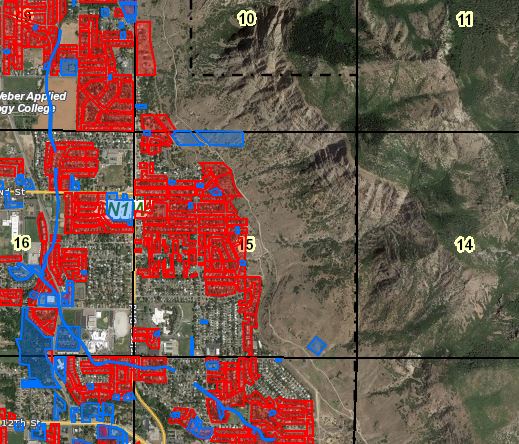
County GIS maps do more than show property lines—they often flag mortgage red flags. Zoom to the parcel, click the property, and scan the Encumbrances tab for lien indicators. Even if mortgage details are missing, you’ll confirm the legal description and parcel ID for deeper searches. Pair this with the tax assessor’s site: if tax bills go to a different address (like “ABC Bank Escrow Department”), it’s a telltale sign a lender holds the mortgage. Recent exemption changes—like dropping a homestead exemption after refinancing—also signal active loans.
Why Tax Records Alone Fail
Don’t rely solely on tax sites—they rarely list loan balances or lenders. Their real power lies in cross-referencing: mismatched addresses or sudden exemption shifts should trigger a county records deep dive. Always verify through the Register of Deeds; tax data hints but never confirms.
Professional Title Tools: Bulletproof Verification

For purchases or legal matters, skip DIY searches and order a Property Profile Report ($50–$150) from a title company. Within hours, you’ll receive:
– Current deed holder
– All open mortgages with lender names
– Exact loan amounts
– Any judgments or secondary liens
This report prevents costly surprises—like discovering a $50,000 HELOC during closing. For full protection, upgrade to a Title Commitment ($200–$500), which the title insurer later underwrites. It’s non-negotiable when buying property; title insurance covers errors in their search.
Real Estate Attorney Review: When Complexity Demands Expertise
Attorneys go beyond database pulls—they interpret legal nuances. Hire one if the property involves trusts, LLCs, or cross-collateralized loans (where one mortgage secures multiple properties). They’ll spot issues like unrecorded mechanics’ liens or foreclosure proceedings invisible to amateurs. Budget $200–$400 for basic verification; complex histories (like 30-year chains) run $400–$800. Worth every penny when inheritance or large investments hang in the balance.
MERS Search: Track Securitized Loans in Seconds
Roughly 70% of U.S. mortgages flow through the Mortgage Electronic Registration System (MERS). When loans get bundled and sold (common with big banks), MERS tracks the paper trail. Go to mers-servicerid.org, enter the exact property address, and get:
– Original lender
– Current loan servicer
– Mortgage ID number
– Origination date
This free tool cuts through confusion when the “lender” on record no longer services the loan. But remember: MERS won’t show private loans from local banks or family agreements. Always pair it with county records.
Digital Databases: Commercial Power at Your Fingertips
Services like DataTree ($25–$50/report) or PropertyRadar ($49–$99/month) deliver mortgage details county sites miss—including current balances and payment status. These platforms aggregate data from thousands of sources, revealing second mortgages and HELOCs hidden in standard searches. For investors analyzing bulk properties, they’re indispensable. But verify critical findings: commercial databases occasionally lag behind county recordings by days.
Cost vs. Speed Comparison
| Method | Cost | Speed | Best For |
|---|---|---|---|
| County online search | Free | 5–10 minutes | Quick curiosity checks |
| Property Profile Report | $50–$150 | 2–4 hours | Buyers verifying before offer |
| Full title commitment | $200–$500 | 1–2 business days | Closing protection |
| Attorney consultation | $200–$800 | 1–3 business days | Complex trusts or legal disputes |
Owner-Permission Methods: The Direct Route
With the homeowner’s written consent, pull a tri-merge credit report via an FCRA-compliant service. Every mortgage—first, second, HELOC—appears with balances, payment history, and lender contacts. This is the only legal way to access current loan amounts without authorization. Never skip the consent step; violating the Fair Credit Reporting Act risks $1,000+ fines per incident.
Lender Verification: What They’ll Actually Share
If county records name “XYZ Bank” as the mortgagee, call their servicing department. Most will confirm a loan exists for the address but won’t disclose balances without borrower permission. Have the property address and owner’s name ready—they’ll often provide the servicer’s contact for payoff letters. Pro tip: Say “I need payoff details for closing” to bypass scripted denials.
Five-Minute Verification Cheat Sheet
For casual curiosity (e.g., “Is my neighbor’s house financed?”):
1. Run a county online records search → filter for mortgages in last 3 years
2. Cross-check with MERS lookup for servicer confirmation
3. Verify parcel ID via GIS map to avoid address errors
For buyers during due diligence:
1. Order a Property Profile Report from a title company
2. Demand seller’s mortgage payoff letters for every listed loan
3. Confirm no unrecorded liens via title commitment
Roadblocks & Real Fixes
“Recent refinance not showing in records!”
→ Check the county’s Daily Index—new recordings take 1–5 days to appear. Ask the seller for their closing disclosure; refinances must record within business days.
“Name misspelled on mortgage vs. deed!”
→ Search by parcel number instead of address. Use wildcard characters (e.g., “Sm*th”) in digital indexes.
“Rural county has no online records!”
→ Call the recorder’s office directly. Many read current lienholders over the phone for free—just provide the parcel ID.
Final Verification Checklist
Before signing contracts or making decisions:
– [ ] Confirmed current legal owner via deed
– [ ] Listed every open mortgage with lender names
– [ ] Verified no Release was missed for old loans
– [ ] Cross-checked parcel number across all sources
– [ ] For purchases, obtained lender payoff letters
You now hold the exact blueprint to find out if a home has a mortgage—no fluff, no dead ends. Whether you spend five minutes on county records or hire a title pro, these methods eliminate guesswork. Run your verification today: the difference between a smooth transaction and a $50,000 lien surprise starts with one documented “yes” or “no.”