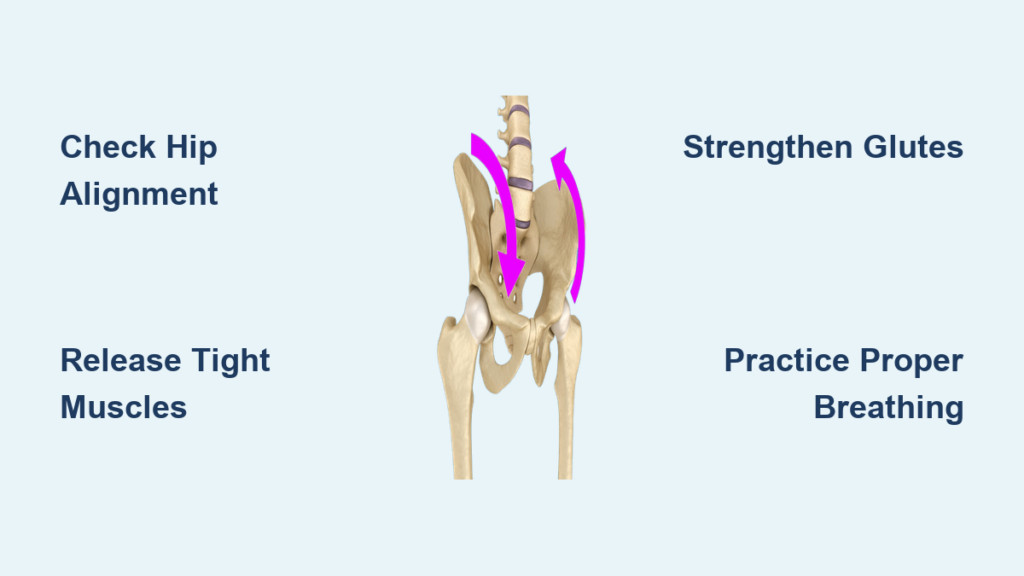
Waking up with one hip higher than the other? Feeling like your legs are different lengths? You’re not alone. Pelvic misalignment affects millions, often stemming from our modern sedentary lifestyles, muscle imbalances, or old injuries. The good news: most cases respond well to targeted home exercises and self-correction techniques.
This comprehensive guide walks you through exactly how to realign your pelvis at home, using proven methods that physical therapists and chiropractors recommend. You’ll learn to assess your condition, perform targeted exercises, and maintain proper alignment long-term—all without expensive equipment or office visits.
Check for Pelvic Misalignment First

Quick Visual Test in Mirror
Stand barefoot in front of a full-length mirror wearing fitted clothing. Look for these telltale signs:
- One hip bone (ASIS) sits higher than the other
- Uneven waist creases when viewed from front
- Shoulders tilted compared to hip line
- Torso rotated slightly left or right
Pro tip: Take photos from front, side, and back views against a plain wall. Repeat weekly to track progress as you continue your pelvic realignment journey at home.
Simple Leg Length Check
Lie flat on your back on a firm surface. Have someone place their thumbs on your inner ankle bones (medial malleoli). Compare their positions:
- Even ankles = likely balanced pelvis
- One ankle extends further = possible pelvic rotation
- Measure from hip bone to ankle bone bilaterally for confirmation
Warning: Differences over 1.5cm warrant professional evaluation before attempting further self-realignment techniques.
Essential Safety Checks Before Starting
When to Skip Self-Treatment
Stop immediately and consult a professional if you experience:
– Severe pain (7/10 or higher) that worsens with movement
– Numbness, tingling, or leg weakness
– Recent trauma or falls within 72 hours
– Loss of bladder/bowel control
– Active inflammatory conditions like rheumatoid arthritis
Red flag: Pain radiating below your knee combined with numbness requires immediate medical attention—don’t attempt home realignment in this case.
Prepare Your Home Setup
Required Equipment List
Must-haves:
– Yoga mat or carpeted floor space
– High-density foam roller (36-inch)
– Light to medium resistance bands
– Tennis or lacrosse ball
– Pillow or folded towel for support
Nice-to-haves:
– Full-length mirror for form checking
– Timer or smartphone
– Comfortable, non-restrictive clothing
Phase 1: Release Tight Muscles (Days 1-3)
Hip Flexor Release Sequence
Kneeling Hip Flexor Stretch (3× daily):
1. Start half-kneeling with back knee cushioned
2. Tuck pelvis by pulling pubic bone toward ribs (posterior tilt)
3. Maintain upright torso, feel stretch in front hip
4. Hold 45-60 seconds each side
5. Progression: Raise same-side arm overhead, gently side-bend away
Foam Rolling Iliopsoas:
– Lie face-down with roller below hip crease
– Support on forearms, slowly roll hip crease to mid-thigh
– Pause 30-45 seconds on tender spots
– Avoid direct pressure on hip bones
Wake Up Your Glutes
Clamshells with Band (3 sets daily):
– Lie on side, knees bent 90 degrees
– Band above knees, feet together
– Rotate top knee upward without rolling pelvis
– 15-20 reps each side
Glute Bridge Basics:
– Supine, knees bent, feet hip-width
– Engage core, squeeze glutes, lift hips
– Hold 2 seconds at top, 3×15 reps
– Progress to single-leg variations when strong
Phase 2: Restore Mobility (Days 4-7)
Spinal Mobility Essentials
Cat-Camel Flow (2× daily):
– Hands and knees position
– Round spine up (cat), then arch down (camel)
– 10 slow, controlled reps focusing on entire spine
Thread-the-Needle:
– On hands and knees
– Slide arm under opposite arm, rotate through upper back
– Hold 20-30 seconds, 3× each side
Hip Mobility Circles
90/90 Hip Rotations:
– Sit with both knees at 90 degrees
– Keep chest tall while rotating between positions
– 2×10 rotations each direction
Hip Circles on All Fours:
– Hands and knees position
– Lift one knee, draw 10 large circles each direction
– Focus on hip joint, not lower back movement
Phase 3: Strengthen and Stabilize (Week 2+)
Core Stability Foundation
Dead Bug Exercise (3× daily):
– Supine, arms up, knees at 90 degrees
– Lower opposite arm/leg while keeping back flat
– 10-12 reps each side, controlled tempo
Side Plank Progressions:
– Start 30 seconds, build to 45-60 seconds
– Progress to star variation (raise top leg)
– 3 sets each side daily
Functional Movement Patterns
Bird Dog for Hip Stability:
– Hands and knees, extend opposite arm/leg
– Hold 5-10 seconds, focus on hip stability
– 3×8-10 each side
Single-Leg Romanian Deadlift:
– Stand on one leg, slight knee bend
– Hinge at hip, reach toward standing foot
– Return using glutes, 3×8-12 each leg
Self-Adjustment Techniques
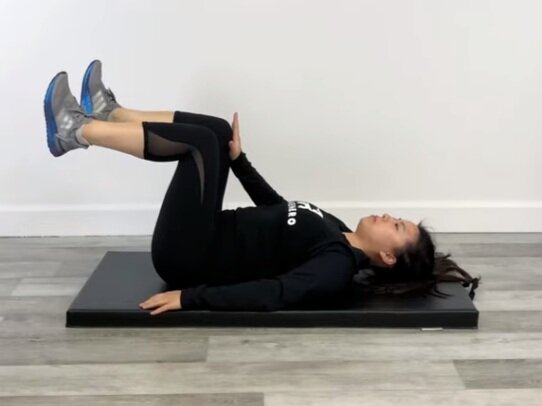
Supine Pelvic Reset (3× daily)
- Lie on back, knees bent, feet flat
- Place palms on hip bones (ASIS)
- Gently rock knees side-to-side 10 times
- Drop knees toward tighter side
- Guide hip bone backward with gentle pressure
- Hold 30 seconds, repeat 3×
Visual cue: You should feel the hip bone move backward with each repetition as you realign your pelvis at home.
Wall-Supported Hip Shift
- Stand sideways 6 inches from wall
- Flex near hip to 90 degrees, foot on wall
- Gently press hip toward wall
- Hold 20-30 seconds, 3× each side
Integrate Proper Breathing
Diaphragmatic Reset
Before every exercise:
1. Lie supine, one hand on chest, one hand on belly
2. Inhale 4 counts through nose, expand belly
3. Exhale 6-8 counts through mouth, draw navel in
4. 10-15 cycles to activate core properly
Why it matters: Proper breathing creates intra-abdominal pressure that stabilizes your pelvis during realignment exercises.
360-Degree Breathing Practice
- Sit tall, hands on lower ribs
- Breathe expanding front, sides, back
- Coordinate with gentle Kegel on exhale
- Practice throughout daily activities
Track Progress Weekly
Sunday Assessment Protocol
Every week, perform:
1. Mirror test for hip alignment
2. Leg length recheck
3. Pain rating 0-10 for back, hips, knees
4. Exercise completion checklist
5. Progress photos from three angles
Tip: Consistent tracking is essential when learning how to realign pelvis at home—it helps you identify what’s working.
Break Through Plateaus
When Progress Stalls
Quick fixes:
– Film your exercises to spot compensations
– Double activation exercise frequency
– Slow down tempo, increase hold times
– Check foot mechanics and thoracic spine
Common mistake: Trying to force alignment rather than allowing gradual correction through proper muscle activation.
Long-term Maintenance Plan
Daily Movement Habits
Micro-break protocol:
– 30-minute reminders to stand/walk
– 5-10 pelvic tilts at each break
– Conscious sitting: feet flat, lumbar support
– Stair climbing: drive through heels, engage glutes
Key insight: Your pelvis didn’t misalign overnight—maintaining proper alignment requires consistent daily attention to your movement patterns.
Know When to Seek Help
Emergency Warning Signs
Seek immediate care for:
– Sudden severe pain (8/10+)
– Progressive leg weakness or foot drop
– Saddle numbness (inner thighs/groin)
– Fever with back pain
– Night pain unrelieved by position changes
Professional Resource Guide
Who to call when:
– Physical therapist: Movement analysis, personalized programs
– Chiropractor: Manual adjustments if self-techniques fail
– Massage therapist: Soft tissue restrictions
– Sports medicine: Imaging for structural issues
– Pilates instructor: Ongoing core strengthening
Quick Reference Timeline
Week 1: Focus on muscle release and gentle activation
Week 2: Add mobility and core stability work
Week 3-4: Progress to functional strengthening
Month 2+: Maintain with daily habits and progressive loading
Remember: Consistency beats intensity. Most people notice improvement within 2-3 weeks of daily practice. Your pelvis didn’t misalign overnight—be patient with the process as you learn how to realign pelvis at home. Track your progress, listen to your body, and consult a professional if you hit a wall or experience concerning symptoms. With proper technique and dedication, you can achieve lasting pelvic alignment without expensive equipment or office visits.