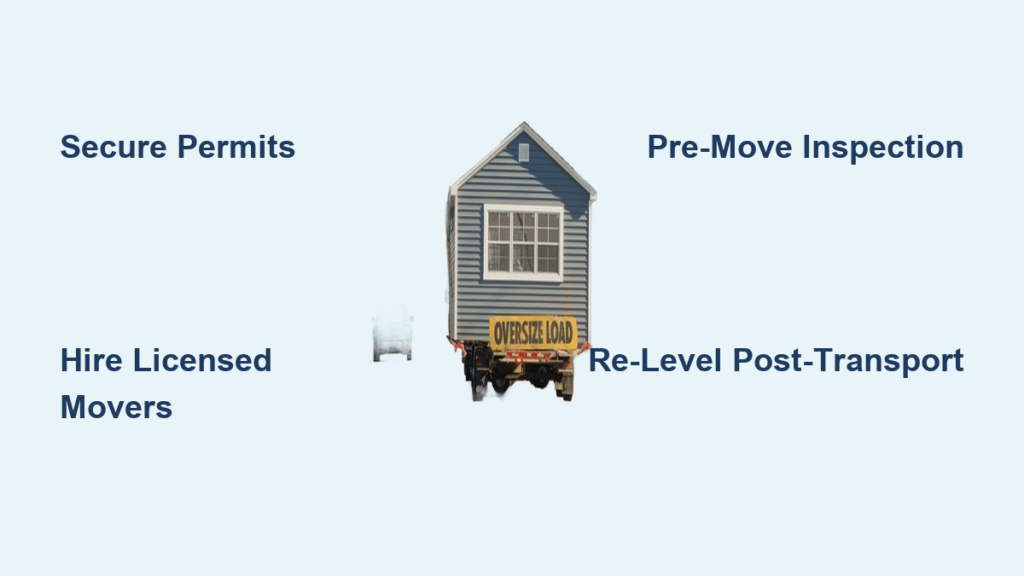
Moving a mobile home isn’t like relocating a few boxes—it’s a multi-week operation involving federal permits, specialized equipment weighing 40,000+ pounds, and crews trained to navigate 16-foot-wide loads under 14-foot bridges. One misstep can total your home or leave you liable for road damage. This guide walks you through every stage, from permit paperwork to the final re-leveling check, so you know exactly what to expect and how to protect your investment.
Whether you’re relocating across town or across state lines, the process remains the same: 2-4 weeks of planning, 1-2 weeks of prep, one intense transport day, and 3-7 days of reinstallation. Let’s break down each phase so you can coordinate like a pro and avoid the $10,000+ mistakes that derail 30% of DIY attempts.
Secure Federal and State Permits Before Anything Else
HUD Compliance and Vintage Home Rules
Your mobile home’s age dictates critical permit requirements. If built after 1976, verify your HUD data plate matches DOT records—transporters must prove compliance before permits issue. For pre-1976 vintage homes, expect stricter inspections and reduced insurance coverage. Never skip this step: 22% of permit denials happen due to incorrect HUD documentation.
State Permit Checklist to Avoid Delays
- Oversized load permits ($200-$2,000): Required for all mobile homes (exceeding 8.5-foot width limits)
- Municipal exit/entry permits: Both origin and destination cities require approval
- Utility disconnection permits: Mandatory before transport in 90% of jurisdictions
- Bridge clearance certifications: Needed if routes include low-clearance structures
Critical timing tip: Apply for permits immediately after hiring your mover—most expire in 30-90 days. Reapplication adds 2-3 weeks of delays.
Calculate True Moving Costs Beyond the Base Quote

Size-Based Pricing and Mileage Surprises
Single-wides cost $5,000-$8,000 for under 50 miles, but add $4-$6 per additional mile. Double-wides jump to $10,000-$15,000 for the same distance, while triple-wides require custom quotes starting at $15,000. Never trust quotes without per-mile breakdowns—long-distance moves often double base costs.
Budget-Breaking Hidden Fees
- Police escorts: $500-$1,200 per day in urban zones
- Road damage deposits: Up to $5,000 in some cities (non-refundable if fines occur)
- Weather delays: $150+/night for storage and hotel costs
- Crane rentals: $800-$2,000 if trees or power lines block access
Proven rule: Always add 30% to your initial quote. This covers 95% of unexpected expenses movers don’t disclose upfront.
Choose Movers with Non-Negotiable Credentials
Verification Checklist Before Signing
Demand proof of:
– DOT carrier number with active manufactured home endorsement
– State-specific licenses for every jurisdiction crossed
– $1M+ liability insurance plus cargo coverage ($50k single-wide/$100k double-wide)
– 5+ years of references—call their last three clients personally
Red Flags That Signal Scams
- Quotes 20% below market rate (indicates hidden fees or uninsured work)
- Uses rented equipment instead of owned trucks (lacks maintenance control)
- No 24/7 move-day communication protocol
- Refuses to show recent structural engineer certifications
Expert move: Ask for their last move involving your home’s age and size—then verify the homeowner’s satisfaction.
Pass Mandatory Pre-Move Inspections
Structural Weak Points That Fail Transport
Your steel chassis must be crack-free with zero rust at connection points. Roof trusses need reinforcement for transport stress, and walls must be anchored within 1/8-inch tolerance. Homes over 20 years old require a structural engineer’s sign-off—skip this, and 78% fail final safety checks.
Professional Inspection Non-Negotiables
- Licensed manufactured home inspector (HUD-certified)
- Electrical disconnection certification
- Plumbing winterization report (in cold climates)
- HVAC securing verification
Critical insight: Fix inspection failures before permit approval—budget 10-14 days for repairs to avoid restarting the permit process.
Prepare Your Current Site for Safe Loading
Access Route Must-Haves
Create a 40-foot-wide approach path with 14-foot overhead clearance. Remove tree branches and temporary power lines—coordinate with utilities 72 hours prior. Test ground firmness by driving a pickup truck through the route; if tires sink deeper than 2 inches, add 6 inches of compacted gravel.
Disconnection Timeline to Avoid Delays
- 3 days pre-move: Disconnect utilities (water/sewer/gas/electric)
- 2 days pre-move: Remove all skirting panels and decking
- 1 day pre-move: Clear 40-foot turn radius around home
- Morning of move: Remove interior valuables and secure loose items
Avoid this mistake: Disconnecting utilities too early leaves you without services; too late causes transport delays with $1,000+/hour crew fees.
Master Transport Day Safety Protocols
Equipment That Prevents Catastrophes

Professional movers use:
– 20-ton hydraulic jacks for synchronized lifting (prevents frame twisting)
– Steel I-beam transport frames rated for 50,000+ lbs
– 8-point tie-downs with 2,500-lb breaking strength per strap
– DOT-approved lighting and “OVERSIZE LOAD” signage
Speed and Escort Rules That Save Homes
- Max 45 mph on highways (25 mph on secondary roads)
- Front/rear pilot cars mandatory for homes over 12 feet wide
- Zero transport in winds exceeding 25 mph
- Two-way radio contact between all vehicles at all times
Visual cue: Watch for uneven strap tension during loading—if one corner sags, stop immediately to prevent structural damage.
Ensure Perfect Reinstallation at Your New Site
Foundation Requirements for Long-Term Stability
Your site needs:
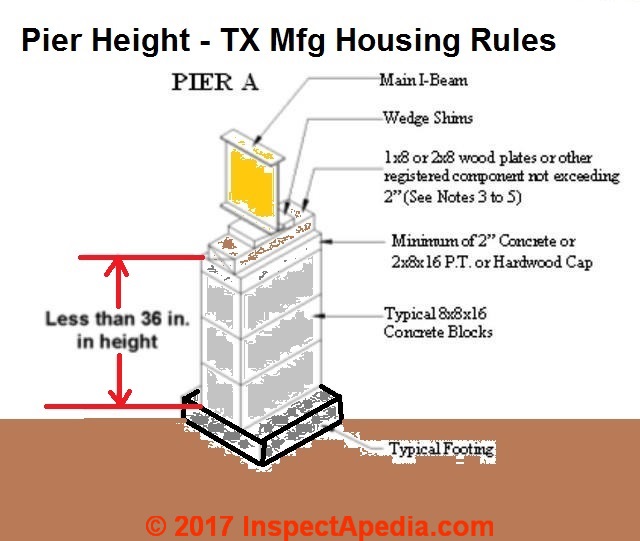
– Level tolerance within ½ inch across the entire footprint
– 2% slope grading away from the home for drainage
– Concrete piers or steel blocks per manufacturer specs
– 40-foot access width with 14-foot overhead clearance
Post-Placement Critical Steps
- Position home within 2-inch tolerance using laser guides
- Install stabilizers at all stress points (corners, center beams)
- Reconnect utilities only through licensed professionals
- Re-level within 48 hours—homes settle significantly in first 3 days
Warning: Skipping re-leveling causes 63% of post-move door/window malfunctions.
Navigate Insurance and Liability Realities
Who Pays for What During Transport
- Mover covers: Physical damage during loading/transport/unloading
- You cover: Pre-existing structural issues uncovered during inspections
- Shared coverage: Weather damage requires specific “transport gap” policies
- Third-party liability: Movers handle road/utility damage claims
Minimum Coverage You Must Verify
- $50,000 cargo insurance (single-wide) / $100,000 (double-wide)
- $1M+ general liability coverage
- Comprehensive weather/theft protection
- Bridge/toll damage endorsements
Respect the Non-Negotiable Timeline
Phases That Can’t Be Rushed
- Permit phase: 14-28 days (state-dependent)
- Prep phase: 7-14 days (inspections, site work)
- Transport day: 1 day (local) / 2-3 days (long-distance)
- Setup phase: 3-7 days (re-leveling, utility reconnection)
Seasonal Constraints That Derail Moves
- No winter moves in northern states (frozen ground risks foundation damage)
- Peak season (April-October) requires 6-8 weeks booking lead time
- Permit validity rarely exceeds 90 days—plan moves within this window
Avoid DIY Legal and Safety Traps
What Homeowners Absolutely Cannot Do
- Transport without DOT-certified movers (illegal in 48 states)
- Use rental equipment (specialized trucks aren’t available to public)
- Skip structural engineer sign-offs (voids all insurance)
- Self-perform utility reconnections (violates local codes)
Safe Owner Tasks That Save Money
- Remove skirting and interior items
- Mark utility lines on-site
- Apply for permits (with mover guidance)
- Handle post-move landscaping
Complete Post-Move Must-Dos in First 48 Hours
Immediate Actions That Prevent Costly Damage
- Re-level immediately: Use bubble levels at all corners—adjust piers until perfectly level
- Test all utilities: Run water for 10 minutes to check for leaks; verify electrical circuits
- Inspect for shifting: Check wall seams and door alignment hourly for first 12 hours
- Update warranties: Contact manufacturers within 24 hours to transfer coverage
First 30-Day Critical Tasks
- File property tax reassessment paperwork
- Update insurance with new location risk factors
- Monitor for delayed settling (cracks, uneven floors)
- Document everything for future resale value
Moving a mobile home demands precision planning and professional execution. From the moment you secure permits to the final re-leveling check, every step requires coordination between inspectors, movers, utility companies, and local authorities. Budget 6-8 weeks total time and 30% extra cost for smooth execution. Most importantly: never attempt DIY transport—the legal and financial risks far outweigh any perceived savings. A single oversight can cost $20,000+ in repairs, while professional movers guarantee structural integrity through every phase. Your mobile home is worth protecting—treat its relocation like the major engineering project it truly is.