Your tomatoes are stunted, your hydrangeas won’t bloom blue, and that new grass seed refuses to germinate. The invisible culprit might be hiding right beneath your feet—your soil’s pH level. Without knowing how to check pH of soil at home, you’re gardening blind, wasting time and money on plants that will never thrive. Most vegetables and flowers need slightly acidic soil between 6.0-7.0 pH to access essential nutrients, but your backyard could be wildly different.
The good news? You don’t need expensive lab tests to determine your soil’s acidity. Whether you’re troubleshooting yellowing leaves or preparing a new garden bed, you can accurately check your soil’s pH at home using methods ranging from high-tech meters to kitchen ingredients. Each approach serves different needs—from weekend gardeners testing a single bed to serious growers managing multiple plots year-round. Let’s dive into the five most reliable methods you can implement today.
Digital Soil pH Meter: Get Lab-Accurate Readings in Minutes

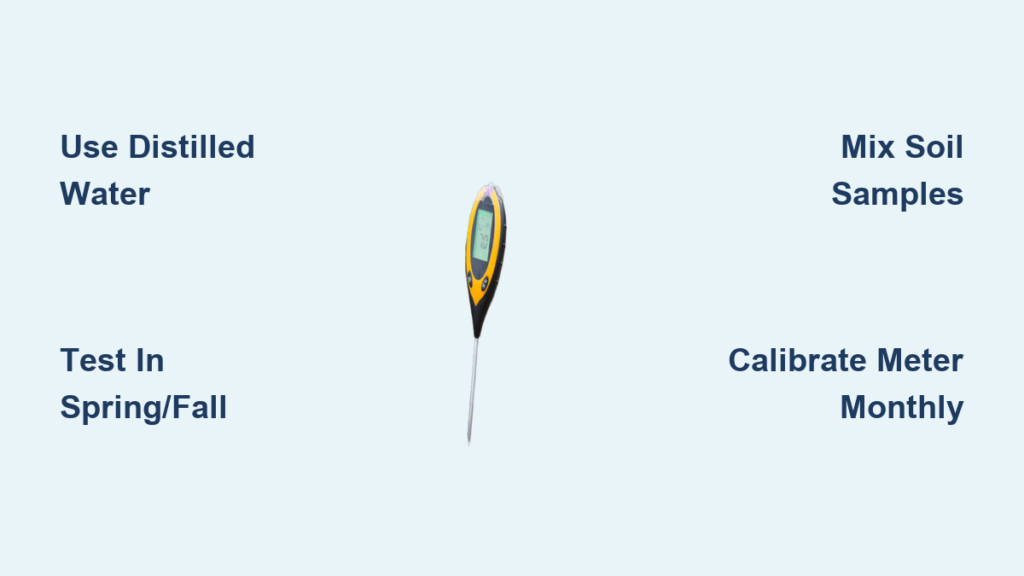
Digital pH meters deliver professional-grade precision without leaving your backyard. These probe-style devices measure within 0.1 pH units, making them ideal for gardeners who test frequently or manage multiple planting zones.
Step-by-Step Testing Procedure for Reliable Results
- Collect proper samples: Dig 4-6 inches below the surface across your garden, avoiding recently fertilized areas
- Prepare the mixture: Combine 1 cup soil with 1 cup distilled water (never tap water) in a clean container
- Wait for equilibrium: Let the mixture sit 30 minutes for accurate readings
- Take the measurement: Insert the probe fully into the water layer, wait 60-90 seconds for stabilization
- Document findings: Record readings from multiple locations to identify problem zones
Critical mistake to avoid: Testing dry soil without adding water. Soil pH meters require moisture to function properly—dry readings are completely unreliable.
Calibration and Maintenance Secrets
Monthly calibration using pH 4.0 and 7.0 buffer solutions is non-negotiable for accuracy. Store the probe in storage solution, not dry, to prevent sensor damage. Replace batteries annually as weak power sources cause inconsistent readings. For best results, take 8-12 samples per 1000 square feet and mix them for a representative reading of your entire garden area.
Chemical Test Kit: The Visual Method That Works for Beginners

Chemical kits transform complex soil chemistry into simple color matching. These affordable $8-25 kits use indicator solutions that change color based on acidity, providing reliable results within 0.5 pH units—perfect for occasional testing.
Why Color Charts Beat Numbers for Most Gardeners
The visual nature of chemical test kits makes interpretation straightforward without technical knowledge. Results appear within minutes, ideal for impatient gardeners who need quick answers before planting. Unlike digital meters, these kits don’t require calibration or batteries.
Pro tip: Test immediately after adding the solution—colors fade quickly, so don’t delay comparison. Use exactly 1 tablespoon of soil to 2.5 parts water for consistent results; improper ratios are the #1 cause of inaccurate readings with these kits.
pH Test Strips: The Fastest Screening Method for Multiple Areas
Test strips deliver the quickest route to soil pH knowledge. Available for $5-15 per pack, these paper strips provide broad-range screening with ±1.0 pH unit accuracy—perfect for identifying problem zones across your property.
Proper Strip Testing Technique to Avoid False Readings
Mix soil with distilled water in a 1:2 ratio in a clean jar, shake vigorously for 2-3 minutes, then let settle for 30 minutes. Carefully dip the strip into the water layer above sediment—never touch soil particles with the strip. Compare to the chart after exactly 15-30 seconds for accurate results.
When to choose strips: Use test strips when checking multiple garden areas quickly or when budget is tight. They’re ideal for screening large properties to identify specific zones needing more precise testing with other methods.
DIY Vinegar and Baking Soda Test: Kitchen Chemistry for Preliminary Assessment
Transform household items into a basic soil assessment tool. This $2-5 method won’t provide exact numbers but quickly identifies whether your soil trends acidic, alkaline, or neutral—perfect for initial diagnosis.
Two-Step Process That Reveals Soil Chemistry
Vinegar test: Add ½ cup white vinegar to dry soil. Vigorous fizzing indicates alkaline soil (pH 7-8). No reaction? Proceed to the baking soda test.
Baking soda test: Mix soil with water until muddy, then add ½ cup baking soda. Fizzing reveals acidic soil (pH 5-6). No reaction to either test suggests neutral soil (pH 7).
Limitation awareness: This method only identifies broad pH ranges, not precise values. It’s excellent for preliminary screening but insufficient for calculating amendment amounts—use it to determine whether you need more precise testing.
Red Cabbage Indicator: The Science Project That Actually Works
Turn red cabbage into a natural pH indicator for under $5. The purple pigment (anthocyanin) changes color predictably across pH ranges, creating an engaging experiment with practical applications.
Creating and Using Your Natural Indicator Solution
Boil ½ chopped red cabbage in 2 cups distilled water for 10 minutes. Strain the purple liquid and cool completely. Mix 2 tablespoons soil with ¼ cup indicator solution and let stand 30 minutes. Observe color changes:
- Deep red: pH 2-3 (highly acidic)
- Red-purple: pH 4-5 (moderately acidic)
- Purple: pH 6-7 (neutral range)
- Blue: pH 8 (slightly alkaline)
- Blue-green: pH 9-10 (moderately alkaline)
Pro tip: Refrigerate the indicator solution for up to two weeks for multiple tests. While less precise than digital meters, this method effectively demonstrates dramatic pH differences between various garden areas.
Avoid These Critical Sampling Mistakes
When and How to Collect Soil Samples Properly
Test soil pH in spring before planting or fall after harvest for most accurate planning. Avoid testing within 2-3 weeks of fertilizing—residual nutrients skew results dramatically. Use clean stainless steel or plastic tools only; galvanized or brass tools contaminate samples.
Correct sampling pattern: Walk your garden in a grid, collecting samples every 10-20 feet. Take 8-12 samples per 1000 square feet at consistent depths (4-6 inches for lawns, 6-8 inches for gardens). Combine in a clean bucket, mix thoroughly, and test your composite sample.
Interpreting Your pH Results for Plant Success

Match Your Readings to Specific Plant Requirements
Strongly acidic (4.0-5.0): Blueberries, azaleas, and rhododendrons thrive here
Moderately acidic (5.1-6.0): Potatoes, sweet potatoes, and most berries perform best
Slightly acidic (6.1-6.9): This sweet spot works for most vegetables, fruits, and flowers
Neutral (7.0): Many herbs and some vegetables adapt well here
Slightly alkaline (7.1-8.0): Lavender, clematis, and lilacs flourish in this range
Nutrient availability insight: pH directly controls nutrient access. Acidic soils (5.0-5.5) reduce nitrogen, phosphorus, and calcium availability. The optimal range between 6.5-7.5 maximizes nutrient uptake for most plants. Above 8.5 pH, iron and zinc deficiencies become severe.
Troubleshooting Inconsistent Test Results
Why Your Readings Might Vary and How to Fix It
Inconsistent readings usually stem from testing technique rather than actual soil variation. Digital meters require monthly calibration with buffer solutions—this is the most common oversight. Ensure consistent sampling depth across tests; surface soil differs dramatically from deeper layers.
Contamination sources to eliminate: Metal tools, recent fertilization, or decomposing organic matter near the surface all skew results. Always wait 2-3 weeks after fertilizing and use plastic or stainless steel tools exclusively.
Choosing the Right Method for Your Gardening Needs
Budget-Friendly to Professional Options Compared
Under $15: Start with vinegar/baking soda test for preliminary assessment, then progress to pH strips for more detailed screening across multiple areas.
$15-30: Chemical test kits offer excellent accuracy for occasional testing. Basic digital meters provide precision for serious gardeners testing 4+ times yearly.
$30+: Advanced digital meters suit market gardeners or those managing multiple plots. Laboratory testing delivers comprehensive analysis including buffer pH and lime requirements.
Final recommendation: Begin with a chemical test kit for your initial garden assessment. Upgrade to a digital meter if you test more than quarterly. Maintain detailed records—soil pH changes slowly, making tracking trends more valuable than single measurements.
Regular soil pH testing transforms gardening from guessing to informed decision-making. Whether you choose high-tech meters or kitchen chemistry, understanding how to check pH of soil at home puts you in control of your garden’s success. Start testing today—your plants will reward you with vigorous growth and abundant harvests. Remember, the difference between mediocre and magnificent plants often comes down to this single, easily testable measurement.