Imagine waking up to find your home flooded or discovering a break-in left your valuables missing. In the chaos that follows, could you remember every item you owned—from your grandmother’s jewelry to your laptop’s serial number? Most people can’t, which is why learning how to create a home inventory isn’t just smart—it’s essential protection for everything you’ve worked hard to build. This comprehensive guide will walk you through exactly how to create a home inventory that ensures you’ll never lose track of your possessions, even when disaster strikes.
Whether you’re a first-time homeowner or have lived in your space for decades, documenting your belongings protects more than just things—it safeguards memories, investments, and your peace of mind. By the end of this guide, you’ll have a bulletproof system for cataloging every valuable, backed up securely, and ready for any insurance claim or estate planning need.
Choose Your Home Inventory Method Based on Value and Convenience
Selecting the right approach for your home inventory determines whether you’ll complete it and maintain it long-term. The three proven methods vary in speed, detail, and security—choose based on your home’s value and your technical comfort level.
Video Walkthrough Documentation That Captures Every Belonging
The fastest way to capture your entire home is through systematic video recording. Start at your front door and move methodically through each room, opening every drawer, cabinet, and closet. Narrate as you film: “Kitchen drawer, purchased these knives in 2022 for $200, Wusthof brand.” This verbal commentary becomes invaluable when you need specific details later.
After filming, immediately upload your video to cloud storage and email a copy to a trusted friend or family member. This offsite backup ensures access even if your home becomes inaccessible. Update this video annually or after major purchases—never store your only copy in your home, as disasters often destroy documentation along with belongings.
NAIC Mobile App: Free Tool for Creating Digital Home Inventory
The National Association of Insurance Commissioners offers a free app that transforms your smartphone into a powerful inventory tool. Download the NAIC app on iPhone or Android to photograph items rapidly while automatically organizing them by room and category. The app stores your data in the cloud, creates backup files for email sharing, and even helps estimate values for common household items.
Key features include:
– Instant photo capture with automatic room categorization
– Dedicated fields for serial numbers and purchase dates
– Offline functionality with automatic cloud syncing
– Backup file creation for secure sharing
Contact the National Association of Insurance Commissioners directly for additional app support and updates—they maintain this resource specifically for consumer protection.
Paper-Based Home Inventory Templates from Department of Insurance
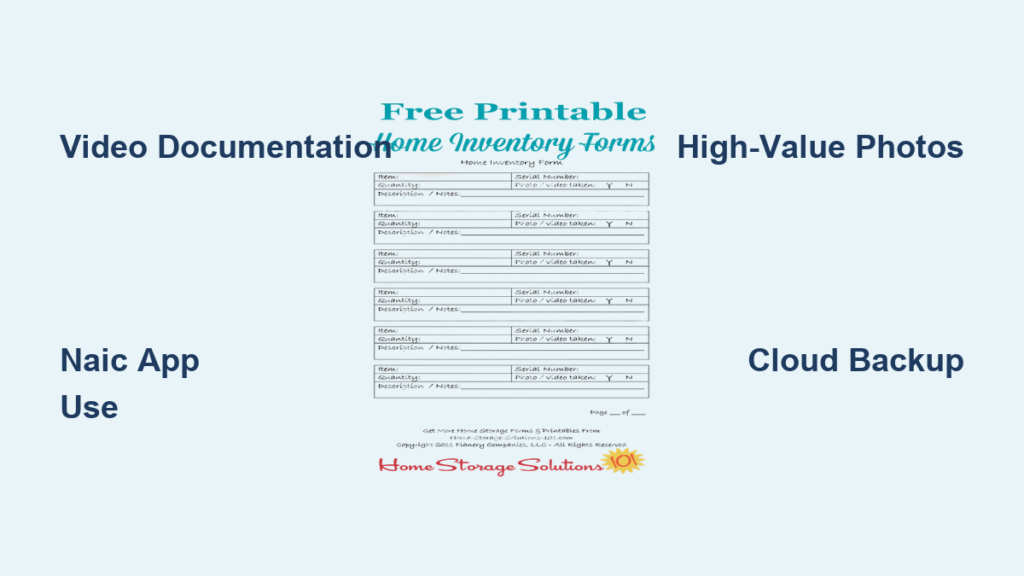
If you prefer traditional methods, the Department of Insurance provides a comprehensive printed guide. Obtain this guide by calling 800-927-4357, downloading from their website, or requesting postal delivery. While slower than digital methods, paper forms work without technology and serve as excellent backup documentation.
Pro tip: Use paper forms as your primary inventory method only if you’re uncomfortable with technology—digital methods offer superior security through offsite storage. If you choose paper, immediately scan and back up your completed forms digitally.
Document High-Value Items with Proper Evidence
Photographic evidence and supporting documentation transform your inventory from a simple list into legally admissible proof of ownership—essential when filing insurance claims.
Essential Photo Requirements for Insurance Claims

Photographs provide irrefutable proof of ownership and condition. For each item, capture multiple angles showing serial numbers, model information, and any distinguishing features. Include a dated label in each photo—write on a piece of paper with the date and brief description, then photograph it alongside the item.
For high-value pieces like jewelry or art, photograph any certificates of authenticity, appraisal documents, and the items themselves from several angles. Critical mistake to avoid: Never take photos without date verification—insurance companies require proof the items existed before a claim.
Critical Supporting Documents Beyond Receipts
Beyond photos, maintain a file with original purchase receipts, warranty information, and appraisal certificates for valuable items. Scan these documents and store digital copies separately from originals. For electronics, record model numbers and serial numbers in both your inventory and on the devices themselves.
Include these often-overlooked documents:
– Mortgage information showing property value
– Insurance policies and any riders covering specific high-value items
– Appraisal certificates for art, jewelry, or collectibles
– Warranty information showing replacement value
Organize Your Home Inventory by Room and Value
A well-organized inventory saves hours during insurance claims and helps identify coverage gaps before disaster strikes.
Room-by-Room Systematic Approach Prevents Missing Items
Start with one room and complete it entirely before moving to the next. This prevents missing items and creates logical organization. Within each room, categorize items by type: electronics, furniture, decorative items, clothing, and miscellaneous.
Create consistent naming conventions: “Living Room-TV-Samsung-65inch-2023” works better than “big TV.” This system helps you locate items quickly and ensures nothing gets overlooked during updates. Key tip: Begin with your most valuable room—typically the master bedroom or living room—to maximize protection immediately.
Value-Based Grouping for Insurance Coverage Accuracy

Organize items by replacement value ranges: under $100, $100-$500, $500-$1,000, and over $1,000. This helps identify items needing additional insurance coverage and speeds up claim processing. Flag custom or irreplaceable items separately—these require special documentation and may need specific insurance riders.
Urgent requirement: Contact your insurance company within 30 days of acquiring high-value items like jewelry, art, or electronics. Many policies have specific limits on categories like jewelry or electronics, requiring additional riders for adequate coverage.
Secure Your Home Inventory Against Disasters
Your inventory is useless if destroyed alongside your belongings—proper storage ensures access when you need it most.
Physical Storage Locations That Survive Home Emergencies
Store paper copies of your inventory in a safe-deposit box at your bank, a secure location at your workplace, or with a trusted relative in a different geographic area. Never keep your only copy in your home where it could be destroyed along with your belongings.
For digital inventories, use multiple backup strategies. Save files to cloud storage services like Google Drive or Dropbox, ensuring automatic backup is enabled. Create physical backup drives stored in separate locations from your home—minimum two backup locations is the industry standard for critical documentation.
Digital Security Protocols for Cloud-Based Inventories

Encrypt sensitive financial information before cloud storage. Test file accessibility every six months to verify data integrity and ensure you can retrieve documents when needed. Set calendar reminders for quarterly backup verification—technology fails when you need it most.
Critical security step: Create a master list of all storage locations and passwords, then share access instructions with a trusted contact. Store this access information separately from your inventory itself.
4-Week Home Inventory Creation Action Plan
Creating a comprehensive home inventory seems overwhelming, but breaking it into weekly tasks makes it manageable.
Week 1: Method Selection and Setup in Under 2 Hours
Choose your preferred documentation method—video, NAIC app, or paper forms. Download apps, order forms, or prepare video equipment. Set up cloud storage accounts and establish naming conventions for files. Complete this phase within 48 hours to maintain momentum.
Week 2: Room-by-Room Documentation Without Overwhelm
Start with your most valuable room—typically the master bedroom or living room. Document every item systematically, taking photos and recording serial numbers. Complete one room per day to avoid overwhelming yourself. Focus on high-value items first if time is limited.
Week 3: Supporting Document Collection Made Simple
Gather receipts, warranties, and appraisals for documented items. Scan paper documents and organize digital files using the same naming conventions as your inventory. Create a master index linking physical documents to inventory entries—this step typically takes 2-3 hours.
Week 4: Storage and Security Implementation Checklist
Upload all digital files to cloud storage with at least two backup locations. Store physical documents in your chosen secure locations. Test all access methods and share retrieval instructions with a trusted contact. Verify everything works before marking your inventory complete.
Most Common Home Inventory Mistakes That Delay Insurance Claims
Don’t wait for the perfect system—start with any method and refine later. Never store inventory only in your home—disasters affect documentation too. Avoid vague descriptions like “nice watch” instead of “Rolex Submariner, serial #12345, purchased 2023, $8,500.” Don’t forget storage areas like attics, basements, and garages where valuable tools and seasonal items hide.
Creating your home inventory isn’t just about protecting possessions—it’s about securing your future and providing peace of mind. Whether you use video documentation, the NAIC app, or paper forms, the key is starting today. Your future self, facing an insurance claim or estate planning meeting, will thank you for this organized, comprehensive record of everything you own.
Begin with one room this weekend. By next month, you’ll have a complete inventory that protects not just your belongings, but the life you’ve built around them.