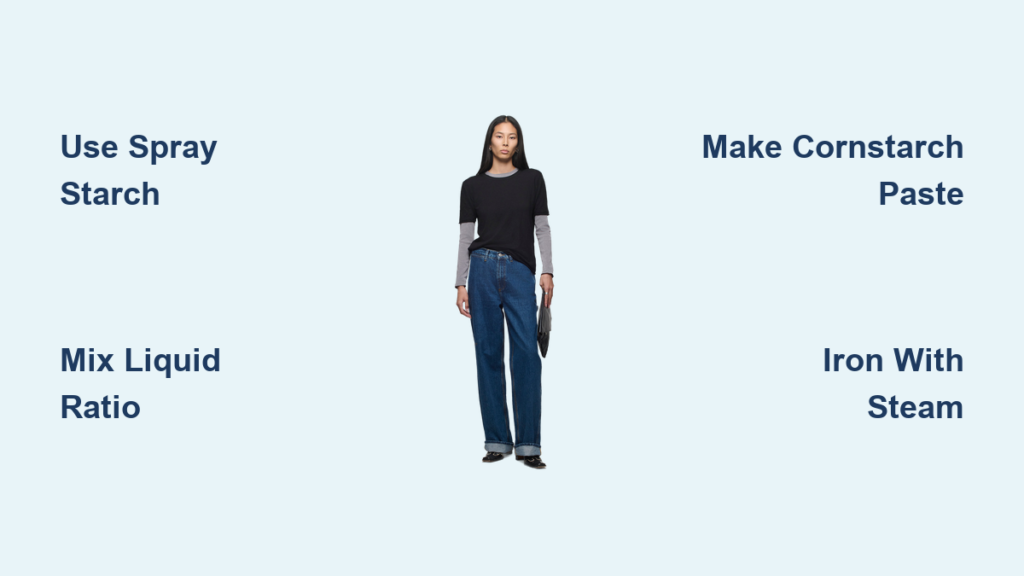
You’ve just pulled your favorite jeans from the dryer, and they’re limp, wrinkled, and completely lacking that sharp, structured look you love. Without knowing how to starch jeans at home, you’re stuck choosing between expensive dry cleaner visits or settling for sloppy-looking denim that won’t hold a crease through your workday. The good news? Achieving that crisp, professional finish is easier than you think when you master the right home starching techniques.
Whether you’re prepping for a job interview, wanting that authentic cowboy jean stiffness, or simply tired of constantly re-creasing your favorite pair, home starching delivers reliable results with minimal investment. This guide reveals precisely how to starch jeans at home using methods that work for every denim type—from delicate vintage pieces to heavy raw selvedge. You’ll learn to control stiffness levels, avoid common flaking problems, and make your crisp look last through multiple wears.
Why Spray Starch Works Best for Quick Jean Stiffening
Spray starch gives you immediate results with minimal effort—perfect when you need crisp jeans in under 15 minutes. This method delivers a 20-30% stiffness increase compared to untreated denim, ideal for everyday wear without that uncomfortable cardboard feel. Start with slightly damp jeans (either freshly washed or lightly misted with water) since moisture helps the starch distribute evenly through the fibers.
Hold your spray starch can 8-10 inches from the fabric and apply in smooth, downward motions—never saturate the denim. Focus extra attention on high-impact areas like creases, hems, and pocket openings where stiffness matters most. Wait 30-60 seconds for the starch to penetrate before ironing to activate the bonding process. For dark wash jeans, always use a pressing cloth to prevent unwanted shine while maintaining that professional finish.
Pro tip: Test your spray starch on an inside seam first. Some formulations can cause slight color lightening on dark denim due to the heat activation process.
Liquid Starch Mixing Ratios for Perfect Denim Stiffness

Liquid starch gives you precise control over stiffness levels while being more economical for frequent use. The magic happens in your mixing ratio: use 1 part liquid starch to 3 parts water for light stiffness (ideal for office wear), 1:2 for medium stiffness (perfect for maintaining creases through a full workday), or equal parts for maximum cowboy-level rigidity. Always mix in a large bowl or sink for easy submersion.
Critical step: Test your mixture on an inconspicuous area first—overly strong solutions create cardboard-stiff denim that cracks uncomfortably when moving. For the most consistent results, completely submerge your clean jeans in the solution, ensuring every fiber gets coated. Gently wring out excess liquid without twisting (which can distort the denim weave), then hang until just damp before ironing.
Homemade Cornstarch Recipe for Chemical-Free Jeans
Create natural, hypoallergenic starch using just cornstarch and water—ideal if you have sensitive skin or prefer avoiding commercial additives. Mix 1 tablespoon cornstarch with 1 cup cold water until fully dissolved, then slowly whisk into 2 cups boiling water. Simmer for 2-3 minutes until the mixture turns thick and translucent, then cool completely before use. Store excess in the refrigerator for up to one week.
This homemade solution delivers 25-35% stiffness with a more natural feel than commercial products, plus you can add 1-2 drops of essential oil for subtle fragrance. The natural composition means less risk of discoloration on dark denim, though it provides slightly less longevity than professional starches. Always strain the mixture through a fine sieve before use to remove any undissolved particles that could cause spotting.
Complete Pre-Starch Checklist for Flawless Results
Never starch dirty jeans—body oils and stains become permanently locked in place. Wash new jeans at least once to remove manufacturing chemicals that prevent proper starch adhesion. For vintage or pre-worn pairs, inspect for weak seams or thinning fabric that might become brittle after treatment. Dark wash jeans require special attention to prevent shine marks during ironing.
Essential tools you’ll need:
– Steam iron with cotton/linen setting
– Sturdy ironing board with adequate padding
– Spray bottle for water misting
– Clean white cotton pressing cloths
– Clothespins for securing creases
– Measuring cups for precise dilution (liquid starch users)
Step-by-Step Spray Starch Application Without Flaking
Begin with jeans slightly damp to the touch—this moisture helps starch distribute evenly without creating water spots. Lay jeans flat on your ironing board, starting with the waistband and working downward in sections. Apply spray starch in smooth, sweeping motions 8-10 inches from the fabric, focusing extra on crease areas. Wait the full 30-60 seconds before pressing to allow proper penetration.
Avoid these common mistakes:
– Skipping the penetration time (causes uneven stiffness)
– Applying too heavily (leads to flaking and white residue)
– Ironing while jeans are bone dry (reduces effectiveness)
– Using incorrect heat settings (too cool won’t activate starch)
Create Razor-Sharp Creases on Dark Wash Jeans

For authentic cowboy-style creases, align inseams perfectly and press a crisp line down each leg’s front. Set your iron to cotton/linen with steam, testing temperature on an inside seam first. Hold the iron stationary for 10-15 seconds per section with firm pressure, using steam bursts along the crease line. Always place a clean white cloth between iron and dark denim to prevent shine marks.
Secure your creases with clothespins while cooling—this simple step makes them last 3-4 times longer through wear. Hang immediately on clip hangers with waistband supported to maintain shape. For traditional five-pocket jeans, create secondary creases along pocket openings to enhance the structured appearance.
Troubleshoot Uneven Starch and Fix Flaking Immediately
Patchy stiffness happens when starch distribution is inconsistent. Fix it by lightly misting affected areas with water and re-pressing with steam in straight lines (not circles). For severe cases where some areas feel papery while others remain limp, wash and restart—trying to fix botched starch jobs usually wastes more time than starting fresh.
Remove stubborn flakes:
1. Let jeans dry completely
2. Brush with soft-bristled clothing brush
3. For persistent residue, soak in cool water with 1 cup white vinegar for 30 minutes
4. Wash normally without additional starch
Prevent future flaking by using less product and ensuring full heat activation during ironing—each section needs proper steam penetration to bond with denim fibers.
Iron Temperature Guide for Different Denim Weights

Set your iron precisely based on your denim’s weight to avoid scorching or ineffective starch activation. Light to medium denim (most everyday jeans) requires standard cotton/linen settings with steam. Heavy raw selvedge needs maximum heat with frequent steam bursts, especially along thick seams and hems.
Critical safety step: Test temperature on an inside seam first—too cool and starch won’t bond properly, too hot and you’ll create permanent shine marks on dark washes. Keep the iron moving constantly except when setting creases, and use oven mitts when handling freshly starched areas—they retain heat much longer than untreated denim.
Preserve Starch Between Wears: 3 Proven Methods
Hang starched jeans on clip hangers with waistband fully supported—never fold them, as this creates unwanted permanent creases. Store in cool, dry places away from humidity above 60%, which significantly breaks down starch effectiveness. For long-term storage, use breathable garment bags to prevent dust accumulation without trapping moisture.
Light starch lasts through 2-3 wears in office environments, while heavy starch maintains crispness through 5-7 wears depending on activity level. Re-starch when creases no longer hold their shape or jeans lose their characteristic “swish” sound when walking. Always wash with cold water and mild detergent before re-starching to remove body oils that prevent proper adhesion.
When to Re-Starch: Knowing Your Jeans’ Stiffness Timeline
Track your jeans’ stiffness journey with these clear indicators: light starch wears off after 2-3 wears, medium after 4-5 wears, and heavy cowboy stiffness lasts up to 7 wears under normal conditions. Office environments extend starch life significantly compared to outdoor activities where movement and humidity accelerate breakdown.
Re-starch immediately when:
– Creases won’t hold their shape after sitting
– Denim loses its crisp “crackle” sound when moving
– Jeans feel noticeably softer than when first treated
– Visual sheen diminishes on darker washes
Remember that each wash removes approximately 90% of applied starch, so re-application is part of the process—not a sign you’re doing anything wrong.
Mastering how to starch jeans at home transforms your denim wardrobe with professional results that last. Whether you prefer subtle crispness for office wear or maximum cowboy stiffness that holds creases all day, the key lies in proper preparation, precise starch application, and correct ironing technique. Start with clean jeans, choose your starch method based on desired stiffness, and build results gradually with multiple light applications rather than one heavy coat. With these techniques, you’ll achieve that signature sharp look without dry cleaner prices—keeping your favorite jeans looking crisp from morning coffee to evening drinks.